Links for 2025-12-23

AI
Recent LLMs can use filler tokens or problem repeats to improve (no-CoT) math performance. The results suggest that recent frontier models possess a form of basic meta-cognition or internal processing capability that allows them to utilize "wait time" effectively, even without explicit reasoning steps (CoT). The author notes this capability likely emerged around the time of Opus 3, as earlier models did not show this benefit. https://www.lesswrong.com/posts/NYzYJ2WoB74E6uj9L/recent-llms-can-use-filler-tokens-or-problem-repeats-to
Even smaller open-source models, specifically Qwen2.5-Coder-32B, possess subtle introspective abilities. https://www.lesswrong.com/posts/zD4McY4NwAsWkcmCH/small-models-can-introspect-too
Continuously hardening ChatGPT Atlas against prompt injection attacks https://openai.com/index/hardening-atlas-against-prompt-injection/
OpenAI built an AI coding agent and uses it to improve the agent itself https://arstechnica.com/ai/2025/12/how-openai-is-using-gpt-5-codex-to-improve-the-ai-tool-itself/
Can a Transformer “Learn” Economic Relationships? https://arpitrage.substack.com/p/can-a-transformer-learn-economic
On AI & creativity: 0 of 7 friends and readers of a New Yorker editor can identify which of 4 passages are from her new novel vs. written by fine-tuned AI. https://www.newyorker.com/culture/the-weekend-essay/what-if-readers-like-ai-generated-fiction [no paywall: https://archive.is/nB4cu]
Robots

When it comes to robotics, I suspect that many people overestimate the progress being made because of impressive-looking hardware demonstrations with fluid motions. These demonstrations can easily create the false impression for non-experts that robots are almost ready to fight autonomously on the battlefield. However, locomotion and whole-body coordination do not equate to reasoning.
Real progress, however, is being made in compositional, generalizable control, such as robots solving multi-step tasks in messy environments. I suspect that many AI skeptics are underestimating how quickly the field is advancing (one example of many: https://h-surgical-robot-transformer.github.io/).
I stand by my following predictions:
By 2030, a robot will be able to cook various meals in an arbitrary kitchen. (70%)
By 2035, robots can do 80% of all physical work at a human level. (70%)
Moravec’s Paradox revisited
Physical Intelligence tries Benjie Holson’s “Robot Olympics”: a set of everyday challenges categorized by difficulty (Bronze, Silver, Gold).
They fine-tuned their latest model, π₀, on these new tasks. Most tasks required less than 9 hours of data collection to learn.
They argue that the solution to Moravec’s Paradox is data. Because the internet (text/video) lacks the “muscle memory” data required for physical interaction, standard LLMs cannot solve these problems alone. However, by building a generalist robot foundation model (like π₀) trained on diverse physical data, robots can learn new, complex physical skills rapidly with relatively small amounts of specific practice.
Read more: https://www.pi.website/blog/olympics
That way lies madness
A friendly reminder that you should not plan for a future where artificial superintelligence (ASI) exists, even if you believe this outcome to have a high probability. That way lies madness.
Imagine the following futures:
World A: In the near future, superhuman intelligence will be developed. This will either lead to our extinction or create a utopia.
World B: AI remains at its current stage of development.
Approximately 100% of the leverage an average person has in shaping their future is within world B. You can control how you fare in this world; you can influence it.
Suppose, for example, we decide to scale back medical training because we won’t need doctors in a world where ASI exists. Why bother studying medicine, then? Let’s just party and have fun, right? Well, sure. But world A isn’t a certainty. Another AI winter is not out of the question. And this is precisely the scenario we should be focusing on. In the worst-case scenario, we’ll have invested several years in something that will later be obsolete. Which is irrelevant in a post-singularity world. But in world B, our decision to indulge in hedonism would be disastrous. And this is precisely where we, as humans, have the greatest leverage. We can do something to improve world B.
In other words: All scenarios involving superhuman AI are irrelevant from a decision-theoretic perspective as long as you’re not directly working to either bring them about or prevent them.
Math & LLM psychosis
There’s an unusually entertaining math/AI drama unfolding on X right now.
David Budden (ex-DeepMind) is publicly claiming he has a solution to the Navier–Stokes existence and smoothness Millennium Prize problem, and that he can deliver a formally checkable proof in Lean.
Many people fear that he might have developed LLM psychosis (which would be notable given his intelligence and knowledge).
There’s a secondary debate about formal proof systems: even if something compiles, what axioms and trusted machinery did it rely on? Some people argue that Lean’s axioms are too strong (Lean’s foundational logic is dependent type theory, not ZFC set theory).
The spectacle has escalated into public bets and prediction markets, including a $10k wager involving Marcus Hutter and a proposed $25k wager with Daniel Litt.
Public pushback has sharpened into “this isn’t a proof”. The Manifold market on the $10k Hutter wager is currently around 98% “Hutter wins” (i.e., Budden doesn’t end up solving/being recognized). A separate Manifold market about how the claim will fail assigns most mass to “no proof/doesn’t compile,” “incomplete (sorry/axioms/etc),” or “wrong problem/formalization error,” with only a tiny probability on “validated as correct.”
As most of this is above my head, I have no opinion other than “big claims are usually wrong”.
References:
Market 1: https://manifold.markets/IsaacKing/will-marcus-hutter-win-his-10000-be
Market 2: https://manifold.markets/Simon74fe/outcome-of-david-buddens-navierstok
Lean file: https://x.com/davidmbudden/status/2002627726877069805
Lean axioms claim: https://x.com/ElliotGlazer/status/2002522818152706280
Budden vs Litt bet: https://x.com/littmath/status/2002319036705620226
LLM psychosis suspicion: https://x.com/davidmbudden/status/2002549962958401849
Math
The unreasonable deepness of number theory https://www.lesswrong.com/posts/hRJ72iSzeACkPGvHt/the-unreasonable-deepness-of-number-theory
The Axiom of Choice is Not Controversial https://www.lesswrong.com/posts/t2wq3znQuPP66DpMT/the-axiom-of-choice-is-not-controversial
Energy
Grid-Scale Bubble Batteries Will Soon Be Everywhere https://spectrum.ieee.org/co2-battery-energy-storage
How America Gave China an Edge in Nuclear Power https://www.newyorker.com/news/the-lede/how-america-gave-china-an-edge-in-nuclear-power [no paywall: https://archive.is/KJRaw]
The Solar Pill: “more power is better, all the energy is solar, and the haters are wrong about everything” https://www.dertaskforce.com/p/dervos-2025-keynote-solar-pill-the
Hardware
This Light-Powered AI Chip Is 100x Faster Than a Top Nvidia GPU https://singularityhub.com/2025/12/22/this-light-powered-ai-chip-is-100x-faster-than-a-top-nvidia-gpu/
Fujikura Ltd.’s stock has surged about 1,400% over the last two years as new data centers globally have created an insatiable appetite for its cables. https://www.bloomberg.com/news/articles/2025-12-18/ai-demand-strains-japan-cable-firm-fujikura-after-stock-surge [no paywall: https://archive.is/YCWQZ]
NIST’s NTP clock was microseconds from disaster https://www.youtube.com/watch?v=ZRB7pjRVVkI
Science
A massive discovery in neuroscience: fMRI signals don't always match true neural activity. In ~40% of cases, signals increased where activity actually decreased. This challenges the core assumptions of tens of thousands of studies. https://neurosciencenews.com/fmri-neural-activity-30057/ (claim this was already known from one of the godfathers of neuroimaging: https://x.com/vdcalhoun/status/2002428433415221265)
A new way to visualize General Relativity https://www.youtube.com/watch?v=wrwgIjBUYVc
The sodium-potassium pump is an information processing element in brain computation https://pmc.ncbi.nlm.nih.gov/articles/PMC4274886/
Philosophy
Many foundational philosophical problems would actually remain unsolved even if God’s existence were a proven fact. https://www.lesswrong.com/posts/qWP7cojpRLFRkxkSF/no-god-can-help-you
Will future beings be intensely jealous of us having been able to live through the singularity? https://www.youtube.com/watch?v=e0QWr_z3re0
Politics
While we are richer, our “minimum viable” standard of living has shifted. We are no longer willing to tolerate the compromises that previous generations accepted as normal. https://www.lesswrong.com/posts/RN58van9PQBGqPxHf/the-revolution-of-rising-expectations
How U.S. Defense Industry Dodged a Rare-Earth Shortage After China’s Curbs https://www.nytimes.com/2025/12/22/business/defense-industry-rare-earth-restrictions-china.html [no paywall: https://archive.is/mXA6n]
How Japan Built a Rare-Earth Supply Chain Without China https://www.nytimes.com/2025/12/08/business/japan-rare-earths-lynas.html [no paywall: https://archive.is/Phza7]
Japan to process rare-earth mud from 2027, tapping deep-sea reserves https://asia.nikkei.com/business/markets/commodities/japan-to-process-rare-earth-mud-from-2027-tapping-deep-sea-reserves [no paywall: https://archive.is/n3OM5]
Why the Lessons of Ukraine Don’t Apply to a Conflict With China https://www.foreignaffairs.com/united-states/americas-drone-delusion [no paywall: https://archive.is/9Gnan]
Ukraine
Ukraine now produces more than 50% of the weapons it uses on the front line. The start-up Fire Point is now producing 200 long-range drones a day. They avoid parts from two specific countries – China and the United States. https://www.bbc.com/news/articles/c1dz6wgn2w9o
Ukraine is leveraging its powerful – and cheap – new drone killers for air defense https://apnews.com/article/russia-ukraine-war-interceptors-drones-nato-c7b57962e573b344490b07b2cfead856
Strikes and Operations
The assassination of a Russian general in Moscow today is just one in a series of operations carried out by Ukraine’s Security Service.
In the initial phase (2022), operations primarily targeted occupation officials and defectors within Ukrainian territory, such as Volodymyr Struk and Oleksiy Kovalyov, alongside psychological strikes against high-profile propagandists inside Russia like Darya Dugina and Vladlen Tatarsky. However, starting in late 2023 and intensifying through 2025, the focus escalated to degrading Russia’s command and technological capabilities. This period was marked by precision attacks deep within Russian borders, eliminating critical figures such as Mikhail Shatsky (a top missile expert), Lt-Gen Igor Kirillov (Commander of CBN Troops), and culminating in today’s assassination of Lt-Gen Fanil Sarvarov, Head of Operational Training for the General Staff.
Since 2022, over 20 high-profile targets have been eliminated, and dozens of lesser-known occupation officials, police chiefs, and other personnel have been blown up or shot.
But assassinations are just one small part of the overall picture. Ukraine’s deep-strike capabilities have evolved from opportunistic asymmetric blows to a systematic dismantling of Russian strategic depth. Early spectaculars like the sinking of the cruiser Moskva (2022) and the Kerch Bridge truck bomb were symbolic turning points that shattered myths of Russian invulnerability. By 2023-24, this matured into a sustained naval campaign that forced the Black Sea Fleet to retreat, marked by the destruction of landing ships (Caesar Kunikov, Novocherkassk) and the submarine Rostov-on-Don. By late 2025, Ukrainian reach extended unprecedentedly to the Caspian Sea (~1,500 km range), where special forces and drones struck missile ships previously considered untouchable. Technological innovation drove this expansion, culminating in the December 2025 operational debut of “Sub Sea Baby” underwater drones against a Kilo-class submarine in Novorossiysk, effectively denying Russia any safe harbor in the region.
There have been many other spectacular successes against military targets. For example, the Toropets 107th GRAU arsenal was destroyed, causing a blast equivalent to a magnitude-2.8 earthquake when 30,000 tons of munitions detonated.
Additionally, Kyiv waged a crippling campaign against Russia’s economic lifelines. The focus shifted from hitting tactical fuel depots (Belgorod, 2022) to launching a strategic air offensive against the backbone of the Russian oil refining industry (Ryazan, Kstovo, and Tuapse) and critical military-industrial plants that produce explosives and avionics.
Tonight, Ukraine successfully hit Russia’s Stavrolen petrochemical plant in the city of Budyonnovsk, Stavropol Krai.
The facility, a major producer of key polyethylene/polypropylene products, is heavily ablaze.

This is the 246th strike/operation I logged since 21 October 2025: https://docs.google.com/spreadsheets/d/1kH4qcGw3fREX3jhGO8c9fNmD9ocF_vikutPNsOo33ls/

There are approximately 3.84 strikes/operations recorded per day over the 64-day period from October 21, 2025, to December 23, 2025.
The gradual rise in frequency clearly shows that Russia is unable to destroy Ukraine’s arms industry. In fact, it is expanding. Ukraine now produces over 50% of the weapons used on the front lines, as well as nearly 100% of its long-range weapons.
Russian losses
Maxim (Maksim) Klimov, a fairly well-known Russian military commentator, argues that Russia’s official manpower figures for the war don’t add up. He points to a headline number aired on the president’s call-in broadcast: roughly 700,000 troops “in the SVO zone.” Then he stacks this against publicly cited inflows since 2022. An initial force of about 400,000, plus 300,000 mobilized, plus successive waves of contract signings (he cites +560k in 2023, +400k in 2024, and ~400k in 2025). In crude arithmetic, he says this implies roughly 2.2 million personnel have passed through the system. This leaves about 1.5 million effectively “unexplained” by the 700k figure.
He argues the discrepancy is too large to ignore and highlights “missing in action” as a major accounting black hole.
Klimov closes with a warning that the country may be approaching “serious trials,” and that in a future national-address moment (“brothers and sisters…”), public demand for the truth about losses will become unavoidable.
(Russian language video available on request.)
Cavalry charge
Russia conducted a cavalry charge against Ukrainian positions.
Pokrovskoe direction, footage from the 5th Battalion of the 92nd Separate Assault Brigade.
Eugenics
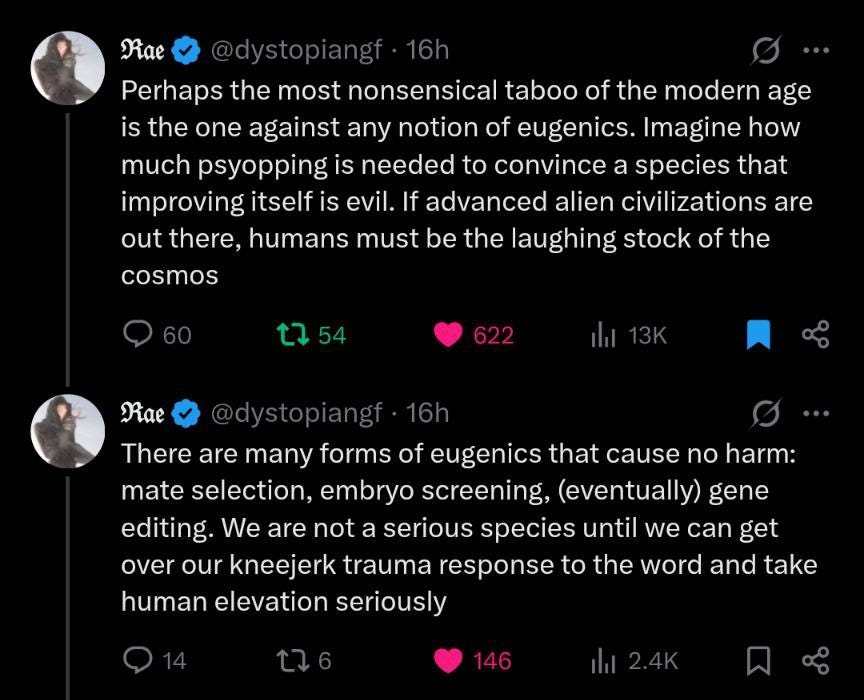
You are probably a eugenicist
Do you believe we need to take the fate of humanity into our own hands rather than continue to play the genetic lottery? Then they will call you a eugenicist.
Do you believe our children deserve to receive the best opportunities we can give them, rather than a roll of the genetic dice? Then they will call you a eugenicist.
Do you believe it is time to face up to the responsibilities that accompany our reproductive choices? Then they will call you a eugenicist.
Do you believe that we should not stand in the way of technological progress that could potentially make the next generation healthier, happier, and smarter? Then they will call you a eugenicist.
Do you believe that we need to wrest control of our genetic destiny from the uncaring claws of nature and shape our future according to our values? Then they will call you a eugenicist.
The knee-jerk reaction is to call those attitudes eugenics and to conjure the specter of fascism. But there is a big difference between desiring a counterfactual world in which someone would not have existed and wishing that someone does not live. Desiring a world without congenital heart disease is not the same as hating people with that disease.
If your parents had had access to advanced reproductive and gene-editing technologies, then you and I might not exist. A smarter, healthier person, with better opportunities, would exist in our place. This person isn’t bothered by their nonexistence. Neither would we be.
Ironically, the same people who believe those attitudes to be illiberal and evil want to take away your liberty to decide which traits your children should have and make you accept whatever fate the uncaring forces of nature have in store for them.
Q&A
Q: How do we draw the line between gene editing and forced sterilization to establish racial hygiene?
A: How do we draw the line between abortion as a right and forced abortions of minorities? Well, easy! We just do. We do so all the time.
Q: Shouldn’t you be using the term ‘liberal eugenics’ because that’s what you are essentially describing?
A: That’s not a viable strategy. Once you start advocating for practices such as gene therapies and embryo selection, people will inevitably call you a eugenicist. The euphemism treadmill won’t save you.
Q: What if people decide to abort every child with Asperger syndrome? It’s easy to imagine how this could have negative consequences.
A: The fact that intelligent designers can make bad choices isn’t an argument in favor of letting the blind idiot god of evolution decide our fate.
Do we need to be careful? Yes! But allowing evolution to possibly turn humanity into some monstrosity isn’t a viable option.